Generate a random field
generate_field.RdGenerate a simulated field
Arguments
- spatial_grid
An sf object that represents the spatial grid
- config_sp
A list that contains the parameters for the variogram model. The list should contain the following parameters:
seed: an integer that sets the seed for the random number generator
psill: a numeric value that represents the sill of the variogram model
model: a string that represents the variogram model. The following models are supported: "Sph", "Exp", "Gau", "Lin", "Mat", "Ste", "Pen", "Hug", "Hol", "Cor", "Sphlin", "Sphexp", "Sphgaus", "Sphmat", "Sphste", "Sphpen", "Sphhug", "Sphhol", "Sphcor"
range: a numeric value that represents the range of the variogram model
nugget: a numeric value that represents the nugget of the variogram model
Details
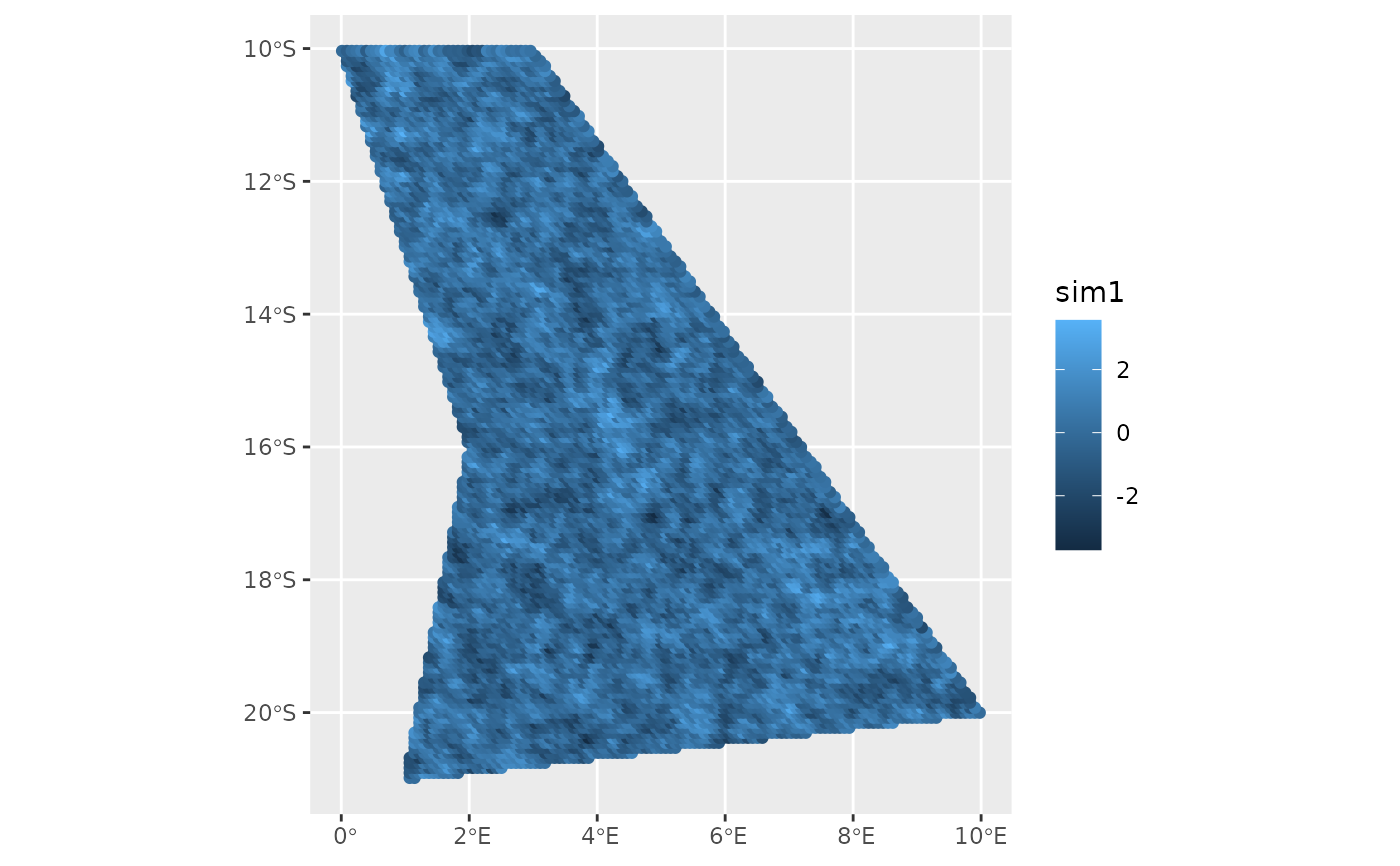
Generate a simulated field using a variogram model and an sf object. In this context a field represents a spatially continuous surface that represents some sort of landscape. This could be a forest or marine system or any other.
Examples
library(sf)
library(gstat)
library(ggplot2)
config_sp <- list(
 seed = 1,
 crs = 4326,
 model = "Exp",
 psill = 1,
 range = 15,
 nugget = 0
)
spatial_domain <- st_geometry(
  st_multipoint(
    x = rbind(
      c(0, -10),
      c(3, -10),
      c(10, -20),
      c(1, -21),
      c(2, -16),
      c(0, -10)
    )
  )
) |>
  st_set_crs(config_sp$crs) |>
  st_cast("POLYGON")
set.seed(config_sp$seed)
spatial_grid <- spatial_domain |>
  st_set_crs(NA) |>
  st_sample(size = 10000, type = "regular") |>
  st_set_crs(config_sp$crs)
simulated_field <- generate_field(spatial_grid, config_sp)
#> [using unconditional Gaussian simulation]
simulated_field |> ggplot() + geom_sf(aes(colour = sim1))