Generate disturbances
generate_disturbances.RmdDetails on disturbances
synthos generates three types of disturbances known to
reduce hard and soft coral cover. Each disturbance has its own spatial
and temporal patterns, reflecting how these processes occur in
reality.
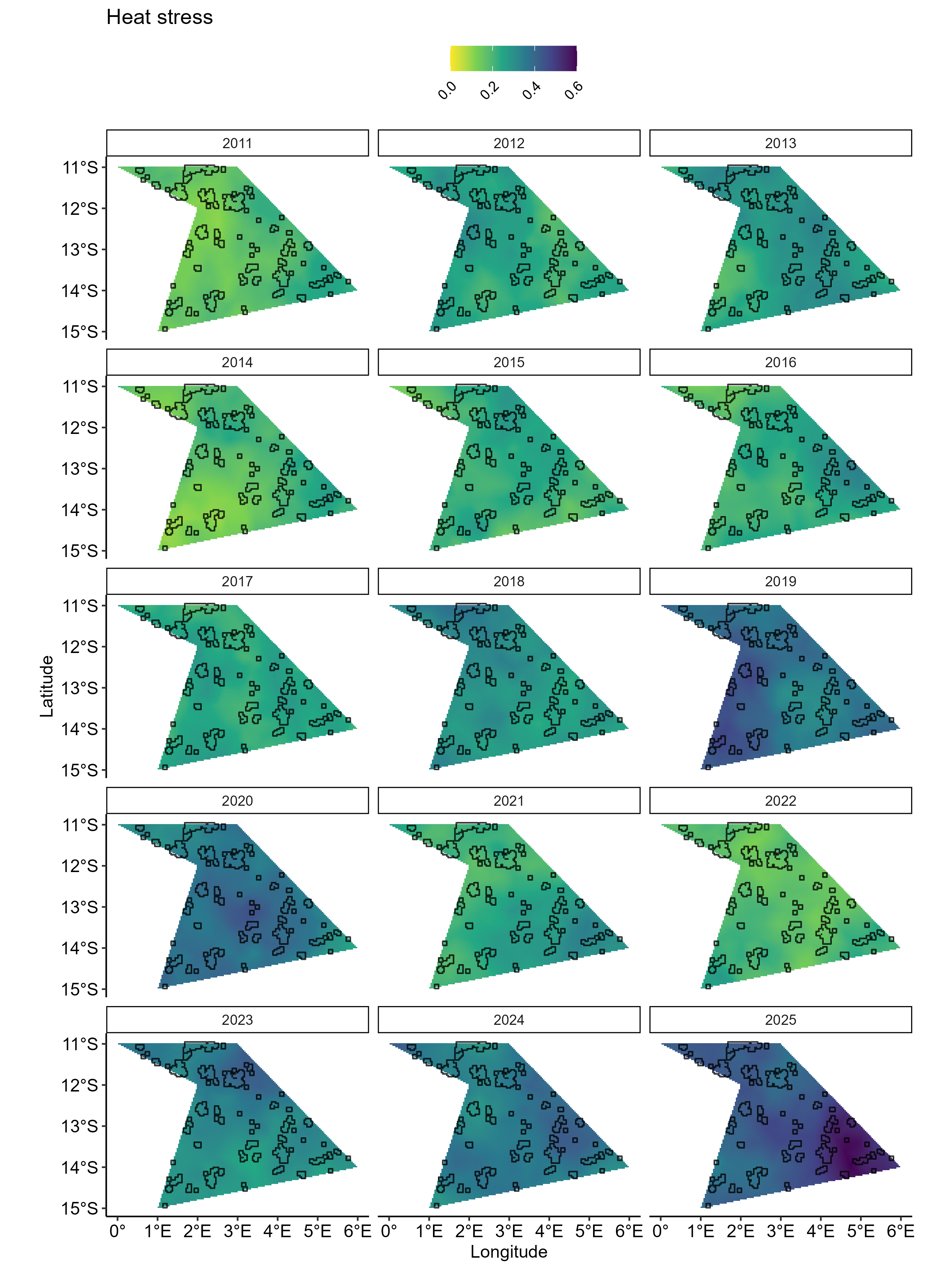
The intensity of a Heat stress event is approximated by the
distribution of Degree Heating Weeks (DHWs) with maximum annual values
correlated with mass coral bleaching and mortality. synthos
modelled heat stress by first generating a temporal DHW signal that
varies form year to year. Random values are then added to the trend to
mimic the yearly variation of heat-stress events under long-term
warming. The resulting temporal signal is then propagated across the
spatial field using a time-varying AR(1)-like process and rescaled
between [0-1] to support comparisons with other disturbances.
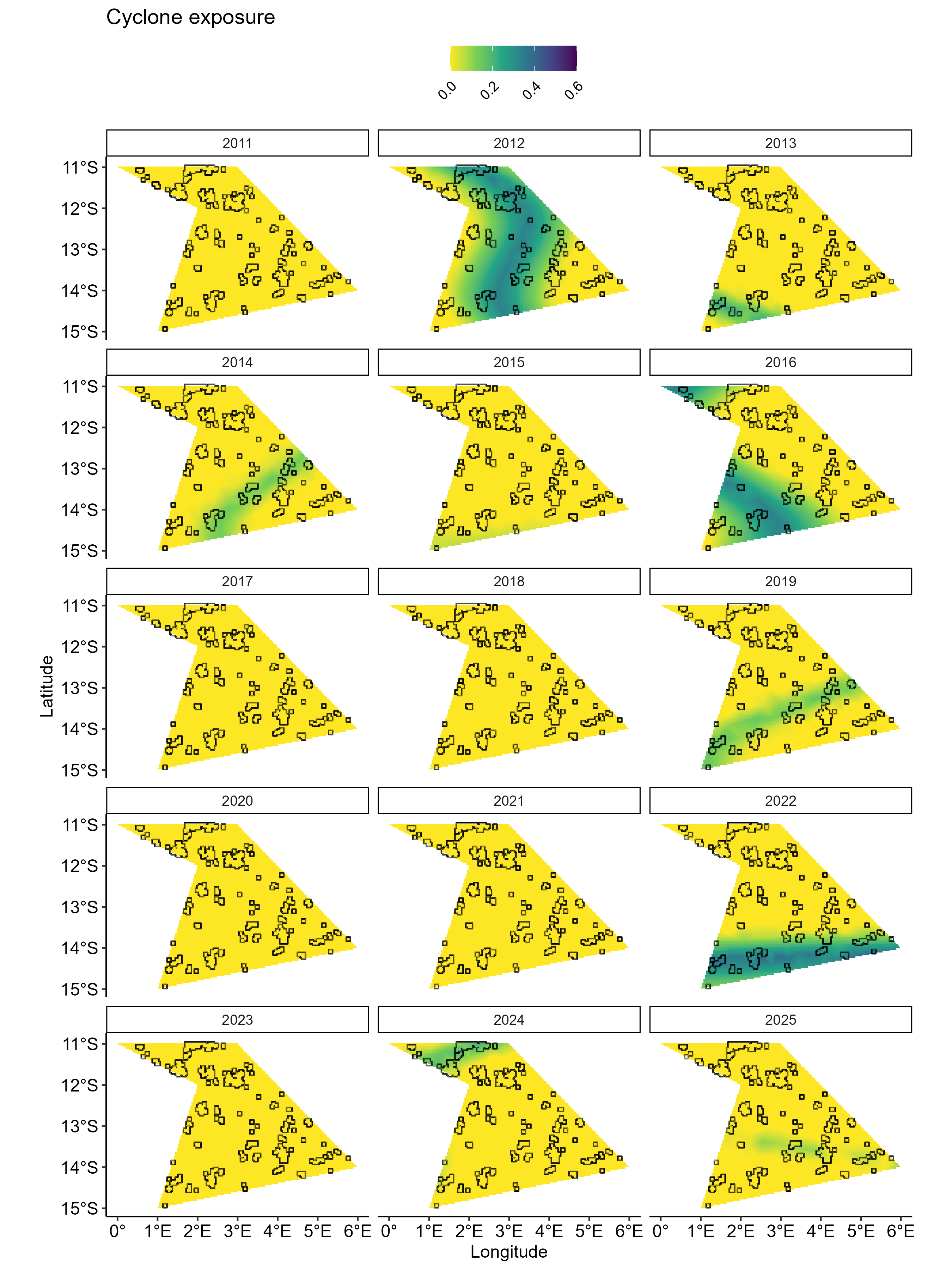
Exposure to Cyclones is modelled through three components:
- their occurrence
- their intensity
- the geographical effect: reflecting the fact that some locations are more susceptible to cyclone exposure than others
Cyclone occurrence in a given year is simulated as a binary event (yes/no) whose probability of happening increases through time. When a cyclone occurs, its intensity is also randomly generated from a probability distribution biased to produce stronger cyclone events on average. Values of cyclone intensity is then used to adjust the geographical effect to produce the fine spatial pattern of cyclone impact and rescaled between [0-1].
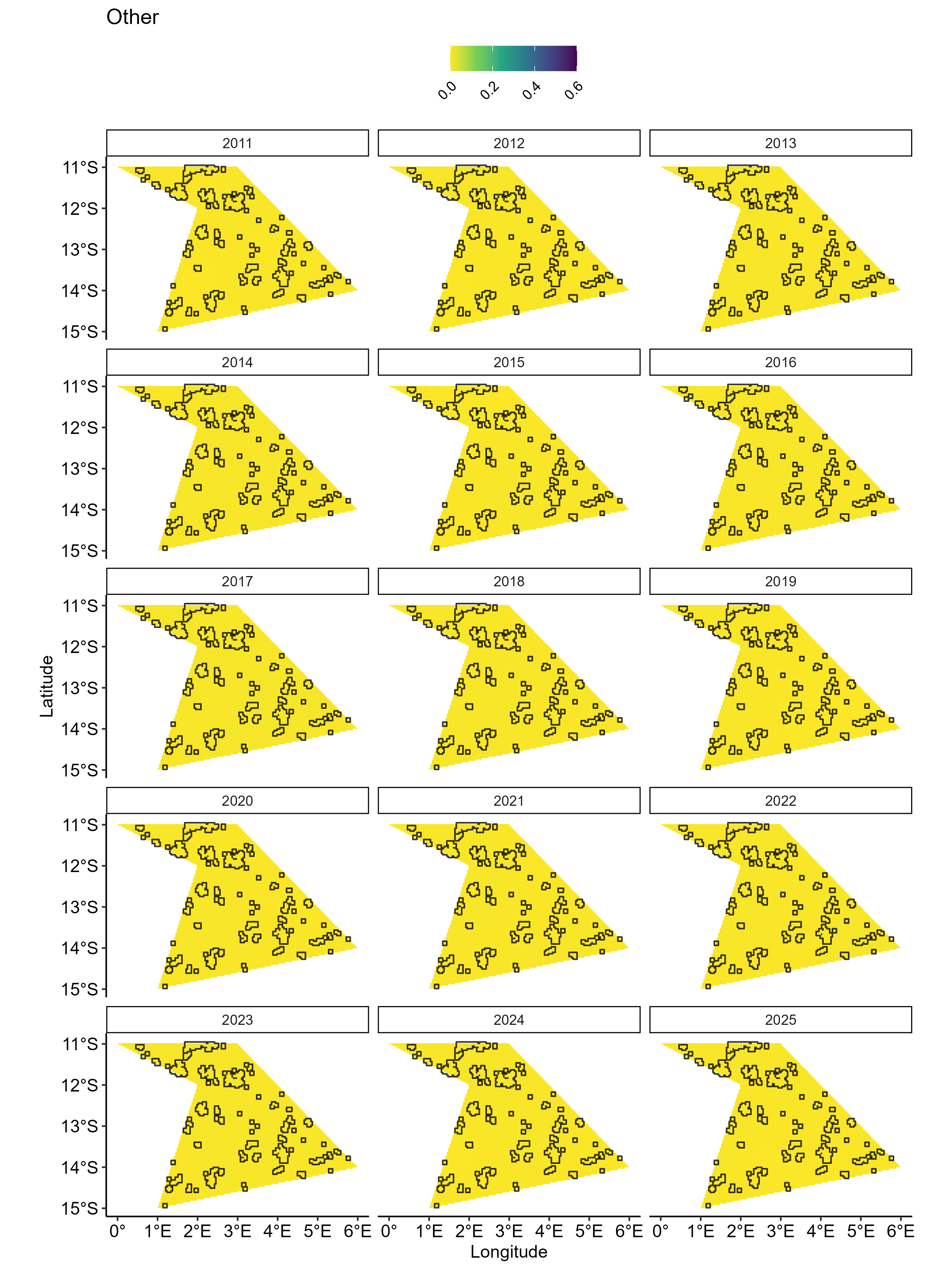
A third disturbance, Other, is generated using the same approach as heat stress disturbance but without the underlying temporal trend. Each year, spatial effects are drawn from a probability distribution parameterized to introduce low temporal autocorrelation values between consecutive years and rescaled between [0-1].
Details on the weighting system
Working with synthetic data requires the ability to recover the input
values, including the effects of disturbances. Although disturbances are
generated using both deterministic and stochastic processes, their
influence can be controlled by applying weights. In
synthos, disturbance values are scaled by user-defined
deterministic weights, providing a simple and transparent way to
modulate their impact. The configuration of the weights can be adjusted
within the function generateSettings.
1. Generate settings
surveys <-  "random" # or  "fixed"
data_type <- "points" # or "cover"

synthos::generateSettings(nreefs = 25, nsites = 3, nyears = 15, dhw_eff = 0.5, cyc_eff = 0.3, other_eff = 0.2)
1. Generate disturbances
spde <- synthos:::create_spde(spatial_grid, config_sp)

######### DHW
dhw.pts.effects.df <- synthos:::disturbance_dhw(spatial_grid, spde, config_sp)$dhw_pts_effects_df %>%
                      mutate(Dist = "DHW") %>%
                      mutate(weight = config_sp$dhw_weight)
######### CYC
cyc.pts.effects <- synthos:::disturbance_cyc(spatial_grid, spde, config_sp)$cyc_pts_effects%>%
                      mutate(Dist = "CYC") %>%
                      mutate(weight = config_sp$cyc_weight)
########## OT
other.pts.effects <- synthos:::disturbance_other(spatial_grid, spde, config_sp)$other_pts_effects%>%
                      mutate(Dist = "OT")  %>%
                      mutate(weight = config_sp$other_weight)

########## All
all.pts.effects <- bind_rows(dhw.pts.effects.df, cyc.pts.effects, other.pts.effects) %>%
                      mutate(Value_weighted = Value * weight) %>%
                      arrange(Dist) %>%
                      mutate(Dist_plot = case_when(Dist == "DHW" ~ "Heat stress",
                                                   Dist == "CYC" ~ "Cyclone exposure",
                                                   Dist == "OT" ~ "Other")) %>%
                       dplyr::mutate(Year = as.numeric(format(Sys.Date(), "%Y")) - max(config_fine$years) + Year)
2. Vizualisation
effects_by_dist <- all.pts.effects %>%
  group_split(Dist)

dist_levels <- all.pts.effects %>% distinct(Dist_plot) %>% pull(Dist_plot)

plots_by_dist <- map2(
  effects_by_dist,
  dist_levels,
  ~ ggplot() +
      geom_tile(data = .x, aes(x = Longitude, y = Latitude, fill = Value_weighted)) +
      geom_sf(data = reefs.sf$simulated_reefs_sf, fill = NA, color = "black") +
      facet_wrap(~Year, ncol = 3)  +
      scale_fill_viridis_c(
        name = "",
        option = "viridis",
        direction = -1,
        na.value = "grey90",
        limits = c(0, 0.6),
        breaks = seq(0, 0.6, by = 0.2),
        labels = scales::number_format(accuracy = 0.1)
      ) +
      coord_sf(crs = 4326) +
      ggtitle(.y) +
      xlab("Longitude") +
      ylab("Latitude") +
      theme_pubr() +
      theme(
        legend.position = "top",
        legend.justification = c(0.5, 1),
        legend.direction = "horizontal",
        legend.text = element_text(angle = 45, hjust = 1),
        strip.background = element_rect(fill = 'white')
      )
)